
For lightweight decorative shapes in solid wood, start with basswood (lime) or a clearly identified poplar product. For assemblies with tabs and slots, start with plywood suitable for laser cutting. For detailed engraving, shortlist basswood, alder and clear, unfigured maple.
There is no single best wood for every laser job. The right choice combines species, product construction and measurable requirements for the finished part.
A quick guide to choosing wood for laser cutting and engraving
Cutting and engraving ask different things of a board. Cutting needs a material that separates cleanly and holds together as a finished part. Engraving needs a surface that produces a readable, repeatable mark. Match the shortlist to the result you need:
- Text, logos and decorative engraving: Start with basswood, alder or clear, unfigured maple.
- Photographs: Start with basswood or alder with a pale face and subtle grain.
- Decorative shapes in solid wood: Consider basswood (lime) or poplar for lightweight parts, and clear birch or hard maple if the part needs to resist bending or wear.
- Sheet assemblies with tabs and slots: Test birch plywood that the supplier confirms is suitable for laser cutting. The core layers and adhesive affect how consistently the laser cuts through the sheet. Measure the actual thickness to check slot fit.
- Flat signs and panels: Consider MDF confirmed suitable for laser processing if you need an even face and can accept dark cut edges.
- Thin sheets and model components: Choose balsa to keep weight down or basswood (lime) if the parts need to withstand more handling.
Use the table below to narrow the choice, then assess a sample from the intended product and batch against your finished design.
Solid wood, plywood or MDF: what are you actually choosing?
Wood for laser work falls into four families: solid wood, plywood, MDF or chipboard, and veneered products. Each family raises a different selection question. Birch plywood is not solid birch, and walnut-veneered MDF is not solid walnut.
| Material family | What it is | Key selection question | Main caution |
|---|---|---|---|
| Solid wood | Boards sawn from one species | Which species, and how consistent is the board? | Grain, colour and density vary between boards and within a single board |
| Plywood | Thin wood layers glued with alternating grain direction | What are the face veneer, core and adhesive? | Verify the actual panel and adhesive suitability; a decorative face does not identify the core |
| MDF and chipboard | Wood fibres or particles bonded with resin | Which product variant and binder? | Suitable MDF products offer an even surface but usually darken at cut edges; chipboard needs separate assessment |
| Veneered products | Thin real-wood face over a core | What sits under the veneer? | The veneer name describes only the surface layer, not the core |
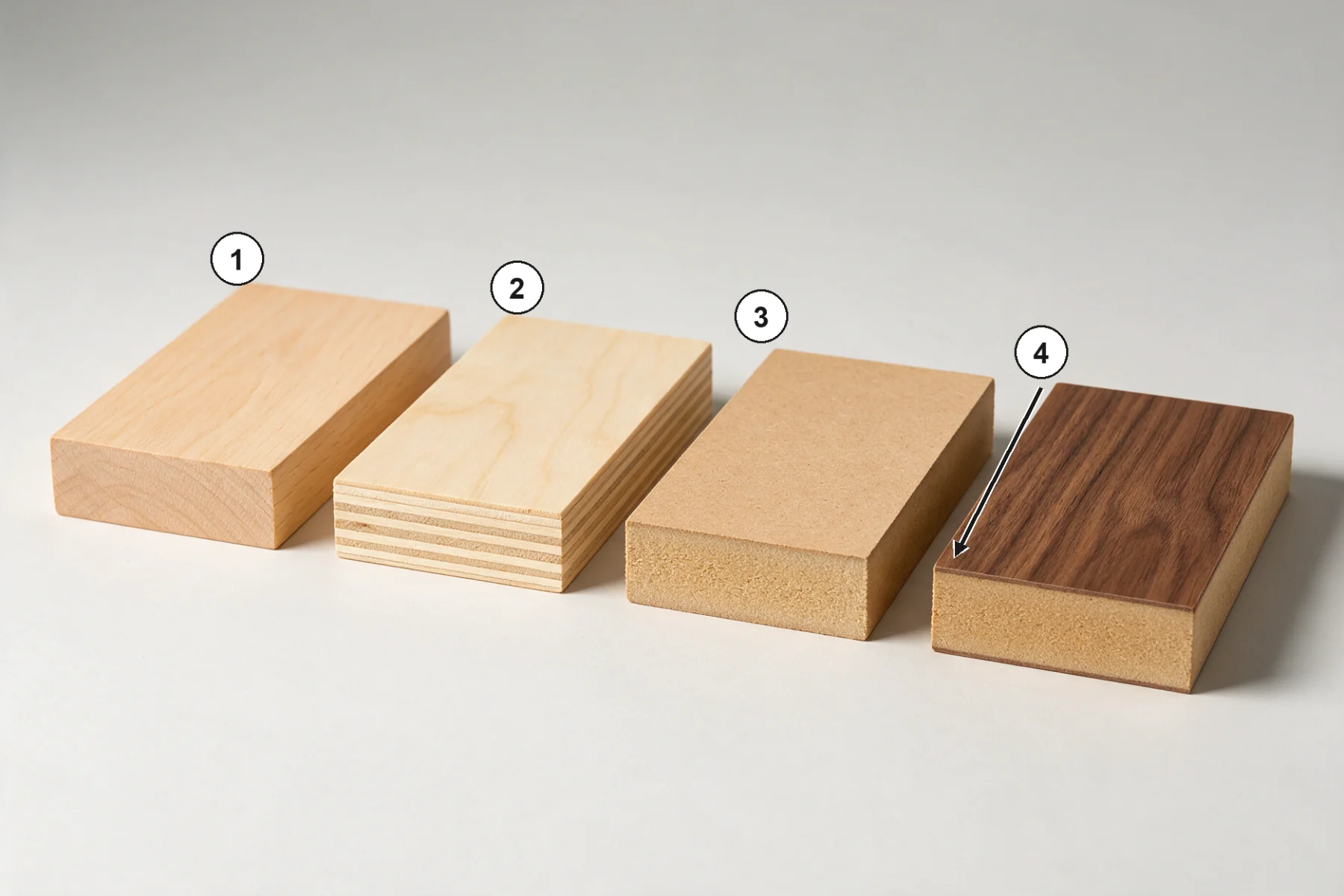
1 - Solid wood. 2 - Plywood. 3 - MDF. 4 - Walnut veneer over an MDF core; the arrow identifies the thin face veneer. Similar-looking surfaces can conceal different constructions.
Hardwood and softwood are botanical categories: hardwoods are angiosperms, while commercial softwoods are generally conifers. These labels do not reliably describe physical hardness. Balsa, basswood, alder and poplar are botanical hardwoods despite their relatively soft wood. Density, grain and resin content are more useful selection criteria than the category alone.
A veneer can show the grain and colour of its solid-wood counterpart, but its thickness limits how much surface material can be removed before the adhesive or core is exposed. Ask for the face thickness as well as the core and finish. A walnut veneer over MDF is a different purchasing decision from solid walnut.
Plywood and MDF each have their own selection criteria and processing requirements. Virmer covers the equipment side on separate pages:CO2 machines for plywood andlaser machines for MDF and chipboard. The rest of this article concentrates on solid wood, with plywood and MDF noted where they change the decision.
What makes wood suitable for laser processing?
Seven properties help determine whether a board suits the job. Check them together: none is a reliable stand-alone predictor of a successful result.
- Grain and uniformity. Fine, even grain is a useful starting point for small lettering and photographs. Pronounced earlywood/latewood differences can produce uneven removal and interrupt fine detail. Judge the actual image area, not a clear corner elsewhere on the board.
- Base colour and achievable contrast. A pale background often makes a dark mark easier to read, but engraving colour also depends on processing and the individual board. Walnut can suit bold decorative work while offering less tonal separation for a photograph. Do not infer contrast from density alone.
- Density, resin and extractives. These affect material removal, deposits and edge appearance. Compare stock at the same thickness before attributing differences to species. Resin pockets can cause local variation even in an otherwise suitable board.
- Thickness and flatness. Specify the permitted minimum and maximum thickness, and check the working area for bow or twist. A sheet that varies from 2.8 to 3.2 mm has a 0.4 mm spread despite being sold as “3 mm”; that matters for fitted assemblies.
- Knots, checks and other defects. Assess the defect-free area needed for the actual parts. For narrow solid-wood components, also check grain direction: a thin neck cut across the grain can be vulnerable even when the species is otherwise appropriate.
- Moisture and conditioning. Match the stock to its workshop and intended service environment. Measure moisture rather than judging it by touch; store thin sheets with support and suitable air circulation. Deliberately soaking wood is not routine material-selection advice.
- Coatings, treatments and construction. Finishes, preservatives, adhesives and hidden cores change both processing behaviour and material safety. Identify them before deciding that a product suits the laser.
These properties affect both operations. Cutting places particular emphasis on thickness, material consistency and part geometry; engraving adds stricter requirements for surface appearance and contrast.
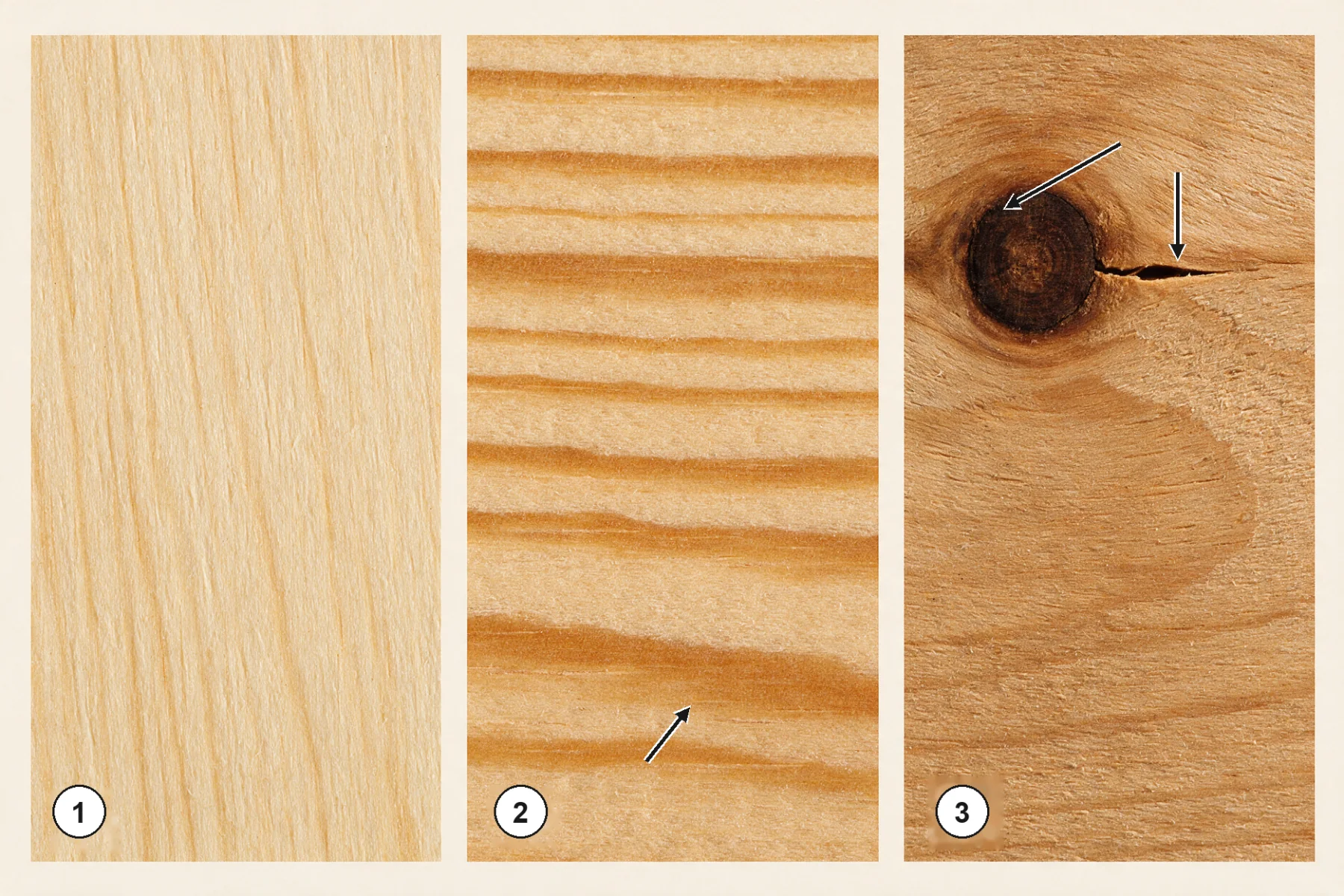
1 - Fine, quiet grain. 2 - Pronounced grain and colour variation. 3 - A knot and an open check. Inspect these features within the actual artwork area.
Put numbers to “light”, “dense” and “conditioned”
For reference, AHEC publishes the following average densities at 12% wood moisture content:
| Identified timber | Average density | Calculated mass of a 100 × 100 × 3 mm solid piece |
|---|---|---|
| American basswood | 417 kg/m³ | 12.5 g |
| American red alder | 449 kg/m³ | 13.5 g |
| American hard maple | 705 kg/m³ | 21.2 g |
The figures come from AHEC's basswood, alder and hard maple profiles; masses are calculated examples. They explain weight differences, not a required laser power or guaranteed strength. European species and individual boards may differ. The 12% reference condition is not a prescribed processing target.
At around 21°C, wood in equilibrium with 40%, 50% and 60% relative humidity has approximately 8%, 9% and 11% moisture content, respectively. These rounded values from the USDA Wood Handbook, Chapter 4 give context for an indoor workshop, rather than one moisture target for every location.
Record workshop humidity and stock moisture before comparing batches. Use a meter suitable for the species and sheet thickness, applying its specified corrections; a meter intended for thick boards may not give a valid reading on thin sheet. Chapter 13 of the USDA Wood Handbook explains moisture measurement and matching wood to service conditions. Acclimatisation time depends on the stock and environment, so “leave it for 24 hours” is not a reliable universal rule.
Solid wood species compared for cutting and engraving
Compare species at the thickness and in the construction you intend to buy. The table separates cutting from engraving and identifies the main trade-off for each shortlist.
| Species | Cutting considerations | Engraving considerations | Best-fit project and limitation |
|---|---|---|---|
| Basswood / lime / linden | A starting choice for thin decorative shapes and model parts; soft edges dent easily | Fine texture and a pale face suit small details; assess the darkness of the actual mark | Models and decorative work. Not a default choice for parts exposed to wear; confirm species |
| Alder | Consider clear stock for decorative profiles; check consistency between boards | Even texture makes it a candidate for text, logos and photographs | Signs and plaques. American red alder and European alder are different species |
| Poplar | Light stock that cuts readily; strength is modest | Colour streaks and sapwood/heartwood variation can make photographs inconsistent | Light components, painted parts. Sort for colour before using for images |
| Solid birch | Consider where more stiffness or surface hardness is useful than in lightweight model woods | Pale, fine-textured clear boards are candidates for detail | Functional small parts and engraving. Assess machine capacity separately; not equivalent to birch plywood |
| Maple | Hard maple is relatively dense; consider it for wear resistance, then verify cutting feasibility at the required thickness | Clear, unfigured stock is a useful candidate for detailed engraving and photographs | Detailed work and handled items. Hard maple, soft maple and European maples differ |
| Cherry | Consider when the natural appearance justifies testing a less lightweight option | Warm base colour suits decorative designs; mark colour and contrast vary | Gifts and decorative panels. Match colour between blanks and assess the intended finish |
| Walnut | Choose for its appearance rather than expecting the easiest cutting behaviour | Dark background may reduce visible contrast, especially in photographs | Premium decorative work and bold graphics. Approve the finished sample |
| Beech | A relatively hard European option for handled parts, subject to cutting feasibility | Fine texture is useful; colour and grain still need assessment | Handled items and engraving. Confirm conditioning and dimensional requirements |
| Balsa | Useful for low-mass models; thin edges and narrow sections damage easily | The soft face can be marked during handling; not the first shortlist for wear-resistant engraved goods | Lightweight models. Design around grain direction and handling loads |
| Oak and pine | Assess pronounced grain in oak and resin pockets or knots in pine | Visible texture and uneven removal can compete with fine text or photographic tones | Rustic graphics. Use clear stock and judge variation across the actual design |
Use these recommendations to select candidates, not to infer a maximum cutting thickness or an identical engraving result from every board.
Naming traps that change what you buy
The same common name can describe different trees on either side of the Atlantic. American basswood is Tilia americana, and the American Hardwood Export Council notes that it is botanically related to European lime. European lime and linden stock may come from other Tilia species, so density, colour and surface can differ.
Poplar has a similar trap. The American Hardwood Export Council states that American tulipwood, Liriodendron tulipifera, is sold domestically as yellow poplar or tulip poplar, is not a true poplar (Populus), and should not be confused with European poplar (see AHEC on American tulipwood). The same page describes strong colour variation between its creamy sapwood and its heartwood, which matters for photographs. For repeat orders, record the botanical species and product code so that a replacement does not silently change the material.
Dark, open-grained and resinous woods
Walnut and cherry raise an aesthetic trade-off. Their rich tone looks attractive, but a dark base can reduce the visible difference between the engraved and untouched surface. In most cases a sample decides whether the result reads clearly.
Oak's pronounced grain and pine's alternating growth bands, resin pockets or knots can produce local differences in material removal. That texture may suit a large rustic logo but interfere with fine lettering or a portrait. Choose clear stock and inspect the result across both lighter and darker bands.
Bamboo sometimes appears on shortlists. It is a grass, usually sold as laminated board, and its behaviour depends on construction and adhesive rather than on a species grade.
Match the material to your project
Match the shortlist to the part, artwork and finish you will actually sell or use.
For cut parts and shapes
Cut one part at its final size and handle it as you would during assembly or use. If a narrow bridge cracks or a tab breaks during fitting, try a different material or revise the design before buying a batch. Check the amount of darkening on any edge that will remain visible.
For text and logos
Engrave the smallest text or logo detail at its finished size on samples from the intended batch. Check that the openings in letters such as “a” and “e” remain clear and that fine strokes stay readable across the grain. If details disappear on some blanks, select stock with a more uniform face.
For photographs
To choose the best wood for laser engraving photos, engrave the same portrait at its finished size on each candidate wood. After applying the intended finish, check that the eyes, mouth and midtones remain distinct. A grain band that hides a facial feature is enough to rule out that blank for the portrait.
Compare the samples under the same light. Our wood laser engraving guide explains how to prepare the image and test a fragment on an offcut.
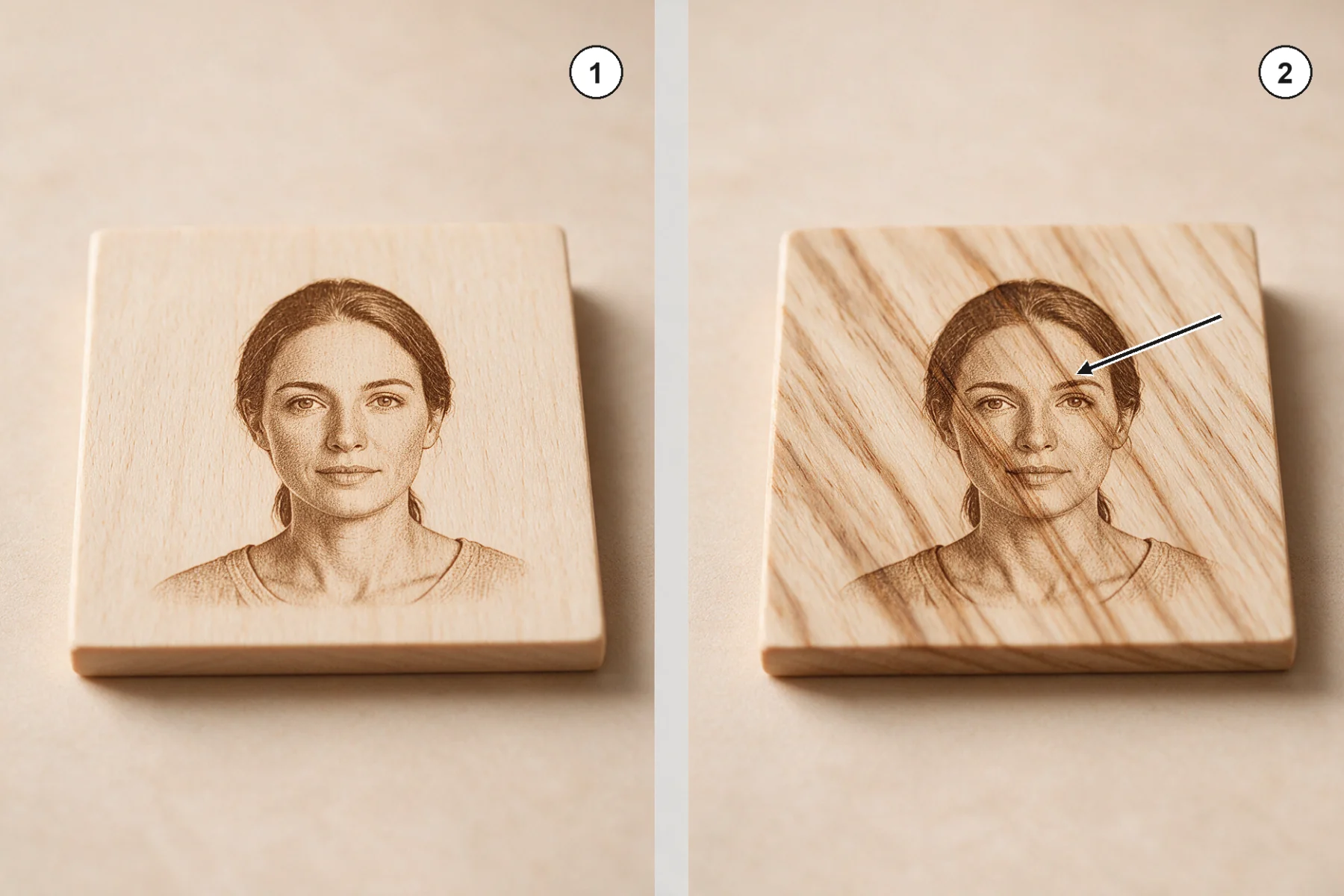
1 - Quiet grain. 2 - Pronounced grain crossing the same portrait. Illustration of grain interference in photo engraving; actual results depend on the stock, artwork and processing conditions.
For thin sheets and model components
Align the grain with long, narrow features in solid wood. If the design has narrow features running in several directions, make a sample in suitable plywood too and check which version holds up better during assembly.
Define “thin” in millimetres on the order. A 1 mm sheet, a 3 mm sheet and a 6 mm sheet present different stiffness, handling and machine-capacity questions; none is a universal laser cutting recommendation.
What to check before buying wood for your laser
A purchase decision rests on a short list of questions to put to the supplier and to the board itself:
- the actual species, including the Latin name where performance matters;
- solid or veneered construction, and what the core and finish are;
- the supplier's confirmation that the product suits laser processing;
- thickness tolerance across the sheet;
- flatness, measured on the board;
- knots, checks and other defects in the working area;
- how the stock has been conditioned and stored;
- whether a sample is available;
- consistency between batches.
Turn “good quality” into a measurable purchase specification
At Virmer, we recommend writing down what the finished part must achieve before ordering repeat stock. The example below is for a small decorative assembly using nominal 3 mm material. Its figures are illustrative purchasing requirements, not an industry standard, a Virmer machine specification or a guarantee that this tolerance suits every design.
| Property | Example requirement | How to assess it |
|---|---|---|
| Actual thickness | 2.90–3.10 mm | Measure a 3 × 3 grid of nine points per sampled sheet, including the centre; record minimum and maximum |
| Flatness | Maximum 0.5 mm gap over a 300 mm working span, in the intended holding condition | Check with a straightedge and feeler gauges; agree a different limit if the artwork or focusing needs it |
| Usable face | No knots, open checks or colour boundaries inside the 100 × 100 mm artwork area | Inspect the actual blank location on the designated engraving face |
| Product identity | Same species, construction, finish and supplier product code as the approved sample | Record the code and batch; reassess substitutions |
For a small incoming delivery, inspecting sheets from the top, middle and bottom of the pack is a useful initial screen, not a statistical guarantee. Choose a fuller inspection plan when reject costs justify it. Keep measurement conditions consistent, including whether flatness is assessed with or without hold-down.
The 2.90–3.10 mm range allows a 0.20 mm spread. If parts must enter a slot, test the thickest and thinnest accepted material in the finished joint: the laser's removed width also affects fit. A nominally 3.0 mm slot does not automatically accept every sheet sold as 3 mm. If the fit fails, revise the material tolerance or design before ordering volume. See our wood laser cutting guide for how to measure kerf and adjust slot fit.
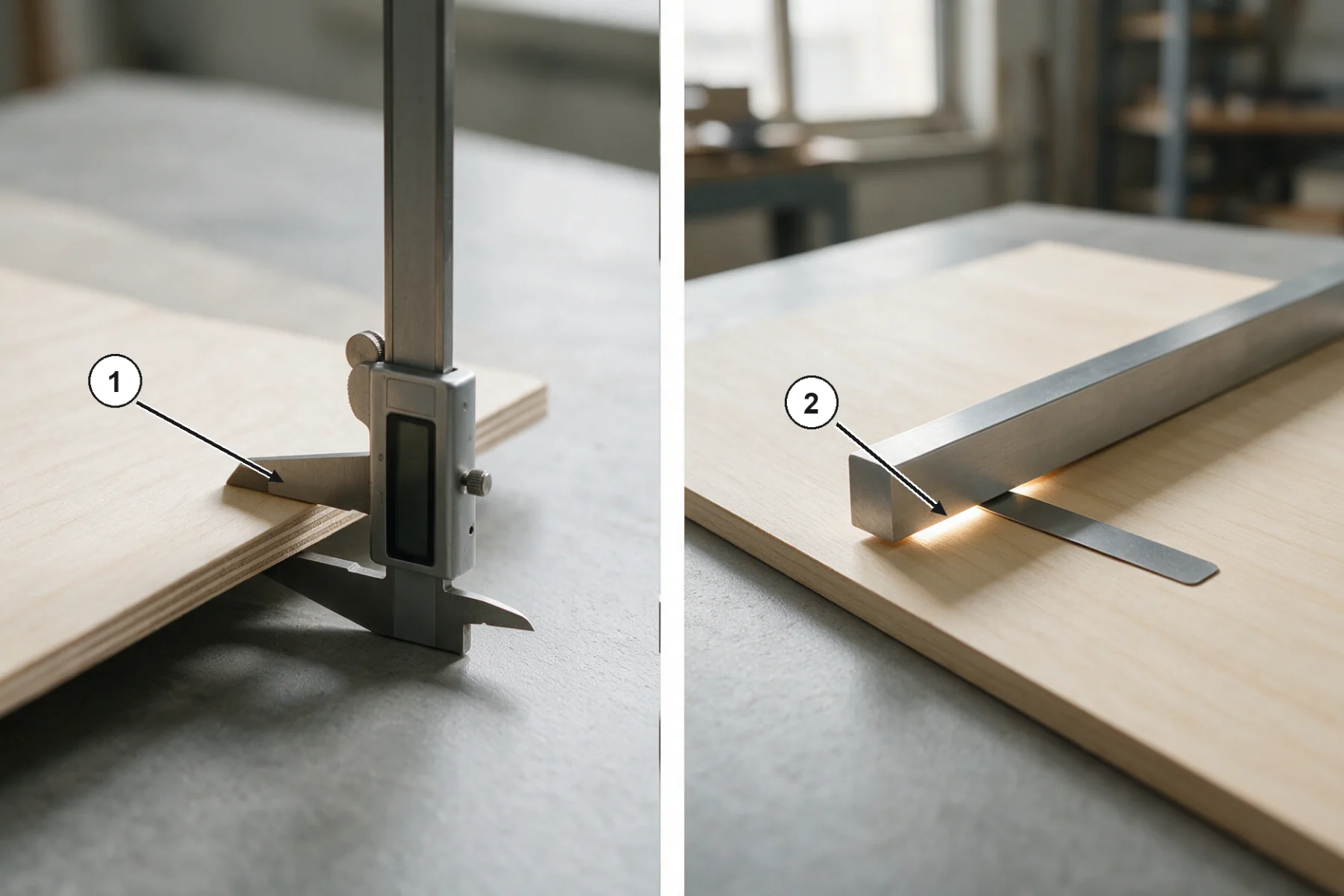
1 - Thickness checked with a caliper. 2 - Flatness checked with a straightedge and feeler gauge. Example purchase requirements: 2.90–3.10 mm thickness and a maximum 0.5 mm gap over a 300 mm span, adapted to the part and holding conditions. This illustration is not a measurement record or a machine-capacity claim.
Test a representative offcut from the intended batch before ordering in volume. Record the product identity, thickness, machine and setup alongside the result. For cutting, judge whether the part separates fully and whether the edge is acceptable. For engraving, judge detail, grain interference and contrast. One good sample does not guarantee every sheet, so repeat the check when the batch changes.
A supplier's "laser-grade" label is a marketing description, not an independent certification. Treat it as a prompt to ask which machine and which test the claim rests on.
Approve the result after the intended finish
Keep a labelled reference sample with the species, product code, batch, face, thickness and machine/setup record. For a new batch, compare against it using the same artwork and lighting. Inspect the smallest text, the finest separate lines and, for photographs, the light, middle and dark areas. Decide which details must remain distinguishable before judging candidates.
Assess the sample after any planned sanding and finish. Sanding can remove shallow detail; oil or clear coatings can change the background colour and perceived contrast. An unfinished sample is not enough to approve a product that will be sold oiled. For veneered stock, check that both engraving and finishing leave the intended face intact. This turns “good engraving” into a repeatable visual acceptance decision.
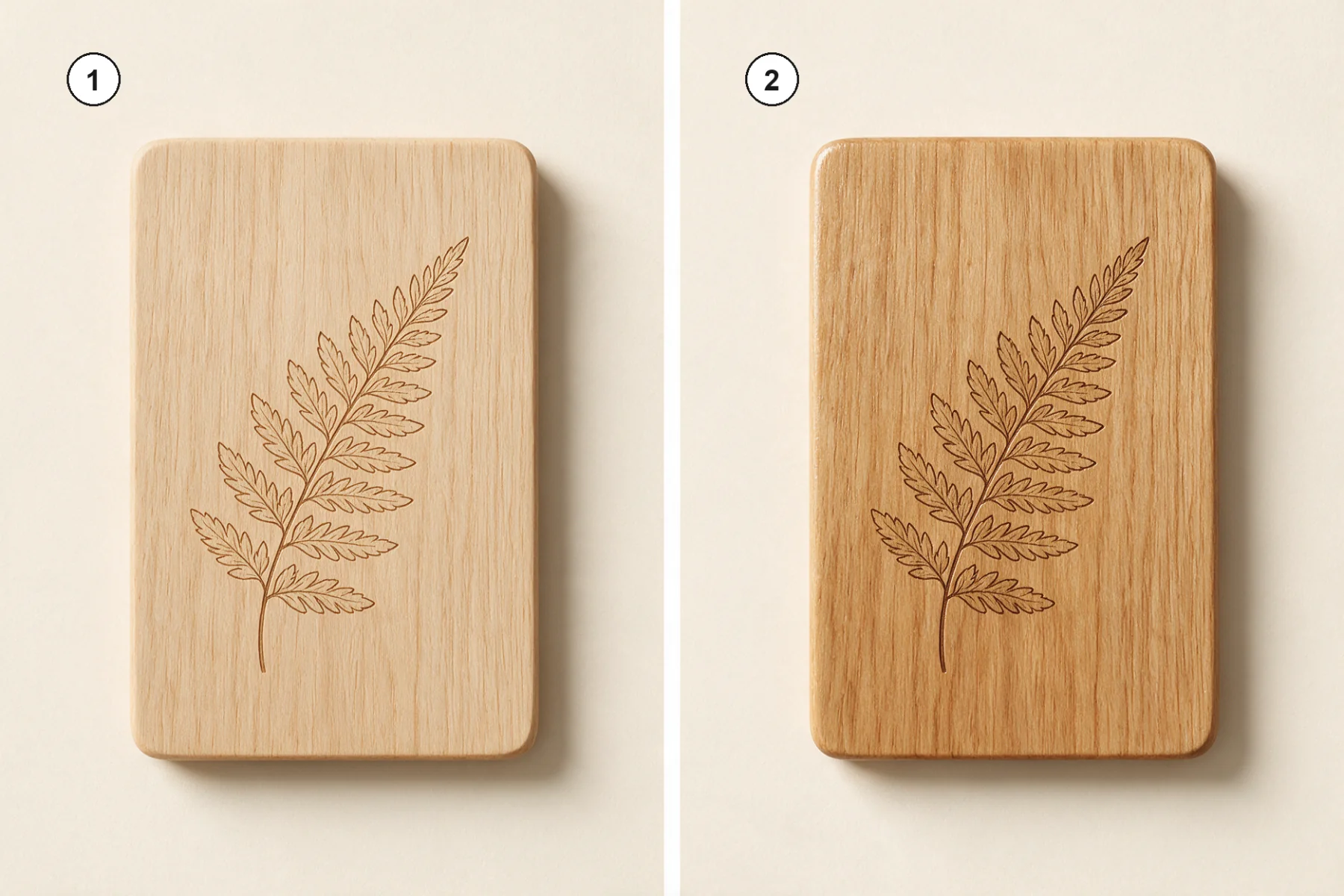
1 - Unfinished surface. 2 - Illustrative clear-oil finish. Approve the appearance in the state in which the product will be used or sold.
Compare cost per usable part, not only sheet price
Include rejects, clear-face area and grain orientation in the comparison. A lower-priced sheet is not cheaper if too many blanks fail the appearance or dimensional requirements.
For an illustrative order, suppose one €20 sheet offers space for 40 blanks but only 30 meet the specification. Its material cost is €20 ÷ 30 = €0.67 per usable blank. A €24 sheet yielding 39 acceptable blanks from the same layout costs €24 ÷ 39 = €0.62 each. The dearer sheet is cheaper per accepted blank. These are example costs, not current supplier prices.
Calculate usable quantity from the actual layout: defects or grain direction may prevent a theoretical area yield from being achieved. Then add processing, inspection and finishing costs separately. This helps compare decorative solid wood with another stock option without assuming that the lowest price per square metre is the best purchase.
Material suitability and safety
Identify the complete product before processing it, including coatings, preservatives, adhesives and facings. A timber species name does not establish the suitability of a treated or laminated product. For unknown finishes, flame-retardant treatments or resin systems, obtain the product composition and laser-processing guidance from the supplier or manufacturer before use. A pleasant smell or a “non-toxic” marketing label is not evidence of safe laser processing.
PVC and PVC-based vinyl must never be processed, since heating can release toxic, corrosive hydrogen chloride and other chlorine-containing gases. Check boards for PVC-based facings or edge banding. Any CO2 laser needs suitable extraction whatever the material.
When a CNC router may suit the wood project better
A CO2 laser cuts profiles and engraves suitable wood without tool contact. A CNC router is often the better choice for pockets, grooves, chamfers, thicker shaped components and parts requiring a defined geometry at depth.
Laser engraving can also remove material to create recesses or relief; the distinction is suitability for the required geometry, depth control, surface finish and production task. If you need an edge without thermal darkening, consider routing and its own tooling and finishing requirements.
For shaped depth and machined features, exploreCNC routers. For suitable flat profiles and surface engraving, compare CO2 cutting and engraving systems. Both technologies can be CNC-controlled.
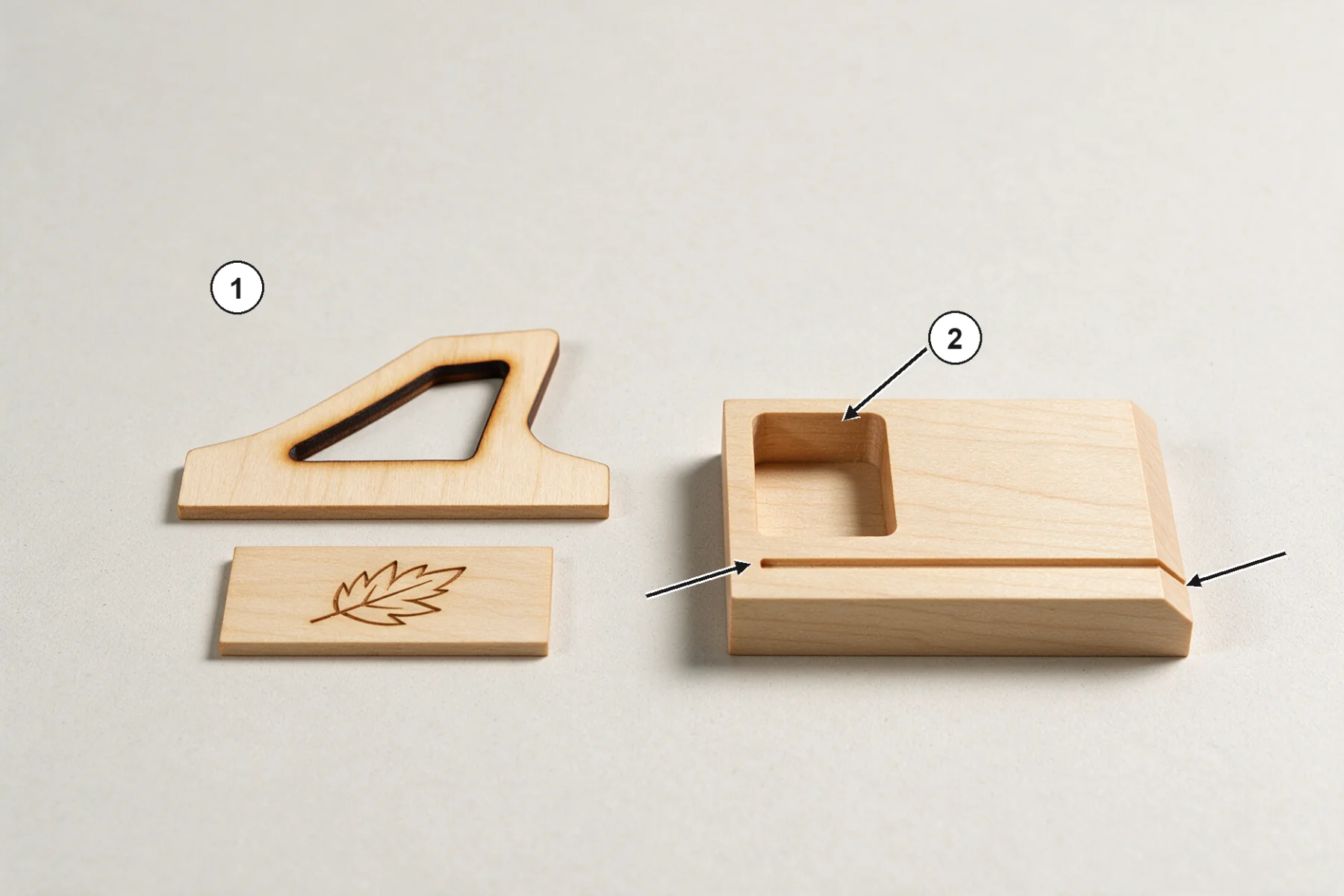
1 - Cut-through profiles and surface engraving, typical CO2 laser applications. 2 - Pockets, grooves and chamfers, typical CNC router applications. Compare the required geometry, depth control and edge finish; these examples do not define exclusive capabilities.
From material to machine
Shortlist the species and product family, define the measurements and appearance your part needs, and approve a finished sample. Keep that reference for repeat purchases.
Frequently asked questions about wood for cutting and engraving
Can the same wood be suitable for both laser cutting and engraving?
Yes. Many woods can be cut and engraved, and a suitable CO2 machine can perform both operations. Assess both results on the intended stock: a board may engrave well but be impractical to cut at its supplied thickness, or cut successfully while its grain interferes with fine images.
Is softwood always easier to laser cut than hardwood?
No. Softwood and hardwood are botanical labels, not measures of density. Balsa, basswood and poplar are hardwoods yet light and soft, while many conifers carry resin and hard growth rings that complicate processing. Density, resin, moisture and thickness predict behaviour better than the label.
Can pine or oak be used successfully?
Sometimes. Neither is categorically unusable, but pine's resin pockets and knots and oak's pronounced grain make results less uniform, especially in engraving. Choose clear, straight-grained boards and test a representative offcut before committing to a batch.
Does a veneer name tell you what the whole sheet is made from?
No. A veneer name describes only the thin face layer. The core, which may be plywood, MDF or chipboard, and the adhesive decide how the sheet cuts. Ask the supplier for the full construction before treating oak-veneered or walnut-veneered board as solid wood.
Is there a single best wood for engraving photographs?
No. Basswood/lime, alder and clear maple are useful starting candidates. Compare the actual photograph at its intended size, then inspect the finished sample for grain interference, tonal separation and retained detail. The best choice for a bold logo need not be the best choice for a portrait.

