





 Martin Todorov

 Riccardo Muscarella

 Emma Rossi

 Matteo Moras

 Lucas Schmidt

 Roberto D'Adago

 Roger Jungo
What a dual-head laser engraver is used for
A dual laser engraver exists for one reason: cutting time is the bottleneck, not working area or budget.
With two independent heads working the same sheet or roll at once, a dual-head machine processes roughly twice the volume in the same time as a single-head machine of the same size, without doubling the floor space. This matters most where order volume is high and turnaround time is tight, such as textile and leather cutting, signage production, and repeat batch work.
A single-head machine of the same working area still makes sense for lower, irregular volumes, where the added cost of a second head would go underused.
Gantry vs conveyor: two dual-head formats
Dual-head machines are available in the same two structural formats as the rest of the large-format range.
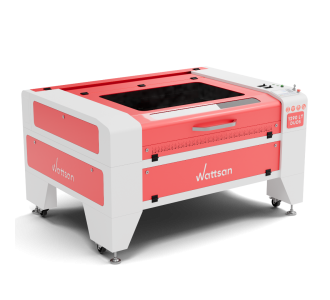
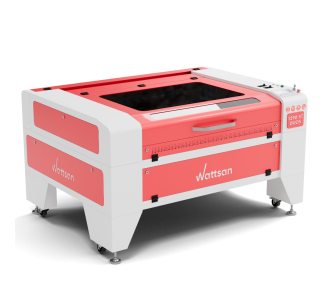
A gantry-style dual-head machine has two gantries moving over a fixed or lifting table, with a working area from 1200×900 mm to 1600×1000 mm and power from 100W to 120W. A static table suits flat sheet material loaded piece by piece, while a lifting table adjusts height for thicker stock.
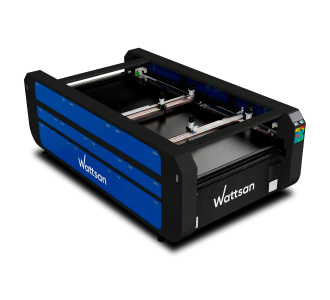
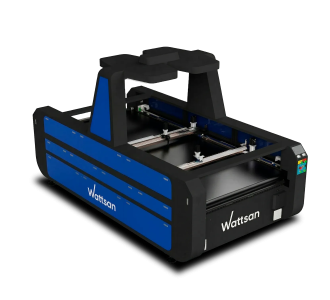
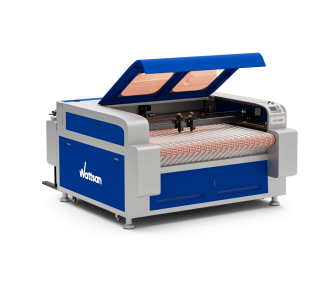
A conveyor-fed dual-head machine is built around continuous roll-fed material rather than a fixed sheet, with a working area up to 1800×2000 mm and power from 100W to 180W. Two heads working the same continuous feed cut fabric or leather panels at double the rate of a single-head conveyor machine, without needing a second, separate machine on the production floor.
How to choose a dual-head laser cutter
Matching a dual-head laser cutter to your production line comes down to four checks:
- Order volume: a second head pays off once cutting time, not floor space or budget, is the limiting factor.
- Material format: fixed sheets suit a portal-style dual-head machine; continuous rolls of fabric or leather suit a conveyor-fed design.
- Working area: 1200×900 mm to 1600×1000 mm for portal-style dual-head machines; up to 1800×2000 mm for conveyor-fed models.
- Power: 100W to 120W for portal-style machines; 100W to 180W for conveyor-fed models, matched to material thickness and density.
Why buy from Virmer
Wattsan dual-head laser cutters are manufactured in China, and Virmer supplies them across Europe as an official distributor, from stock. Every CO2 laser cutting and engraving machine comes with a 24-month warranty, extendable up to 5 years, along with technical support and after-sales service, and a free online demo lets you see both heads running before ordering.
Frequently Asked Questions About Dual Head Laser Cutters & Engravers
What is a dual-head CO2 laser cutting and engraving machine?
A dual-head CO2 laser, sometimes called a double-head laser cutting machine, has two processing heads that can work on repeated parts in parallel within one working area. It handles both cutting and engraving, and using two heads can increase throughput without installing two separate machines. Head movement may be synchronised or independently controlled, depending on the model.
When should I choose a dual-head instead of a single-head laser?
A dual-head machine suits businesses that regularly produce identical or repeated parts, where the layout divides efficiently between the heads and cutting or engraving time is the production bottleneck. It also avoids the extra floor space and infrastructure two separate machines would need. A single-head machine is generally more flexible for large, irregular, one-off, or frequently changing designs.
Does a dual-head laser cutter double production speed?
Not automatically - it can approach twice the cutting or engraving output only on suitable repeated layouts. Actual throughput depends on part dimensions, spacing between the heads, material and settings, layout efficiency, and loading/unloading time. On well-matched repeated jobs, a dual-head machine can significantly increase throughput, but two heads don't automatically double total production capacity.
Do both laser heads work independently?
It depends on the machine design. Sheet-fed DUOS models may run the heads synchronised or divide the working area into separate processing zones, and can often use just one head when needed - the Wattsan 1290 Duos is an example. Selected DUAL conveyor models, such as the Wattsan 1820 CAM Conveyor PRO DUAL, use two independently moving gantries. Confirm zone control and independence for your specific model.
Can a dual-head CO2 laser both cut and engrave?
Yes. Cutting uses higher power and lower speed; engraving uses lower power and higher speed. Both heads can normally run repeated cutting jobs or repeated engraving jobs in parallel, but that doesn't necessarily mean one head can cut while the other engraves a different design at the same time - confirm independent mixed-operation capability for your specific model and controller.
Which materials and products suit dual-head laser processing?
Dual-head processing works best where a repeated layout lets both heads run the same job efficiently: fabric and leather panels, signs and nameplates, packaging components, puzzles and souvenirs, and repeated parts in wood, laser-grade plywood, acrylic, paper, or cardboard. Suitability depends more on part repetition and layout than on the material alone - and only confirmed laser-compatible materials should be used. PVC must never be laser cut or engraved.
Should I choose a fixed table, lifting table or conveyor?
A fixed table suits flat sheet materials of consistent thickness. A lifting table accommodates materials or objects of different heights and may support a rotary attachment. A conveyor suits roll-fed fabric, textiles, and leather needing continuous feeding. A conveyor machine can still use one or more gantries - it's not an alternative to a gantry system. Choice depends mainly on material format and workflow, not just working-area size.

